If you run a VAT-registered business in Oman, you have probably heard the word “Fawtara” recently. Maybe your accountant mentioned it. Maybe you saw it in a government notice. Either way, if you are not yet prepared for the Oman e-invoicing 2026 mandate, this article is for you.
Here is everything you need to know — in plain language — about Fawtara e-invoicing Oman: who it affects, the deadlines, the technical requirements, and what you need to do right now.
What is Fawtara?
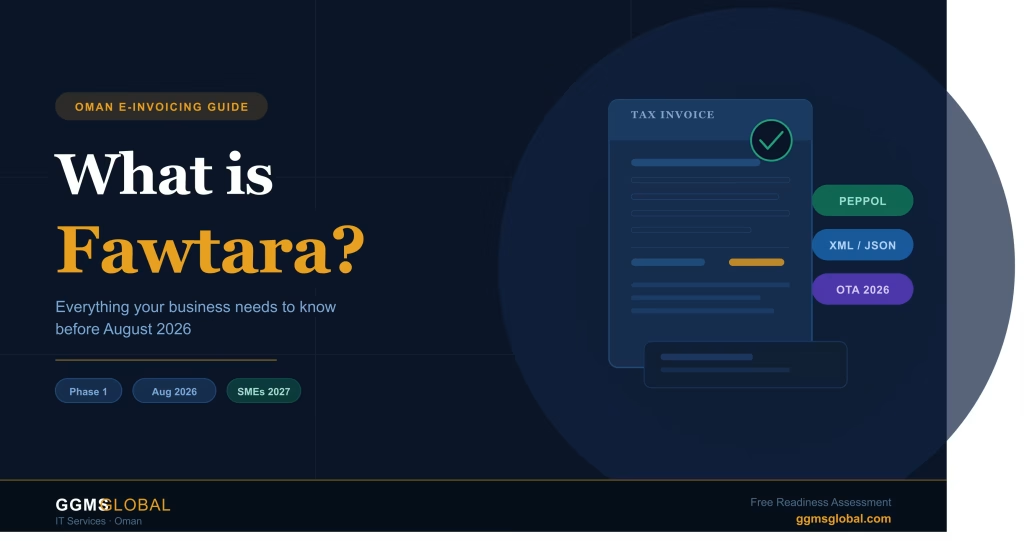
Fawtara (فاتورة) is the Arabic word for “invoice.” It is also the name of Oman’s new national e-invoicing system, launched by the Oman Tax Authority (OTA).
Under the Fawtara programme, all VAT-registered businesses in Oman will be required to stop issuing paper invoices and PDF invoices, and instead issue structured electronic invoices through an approved digital system. These e-invoices are validated in real time and reported directly to the OTA.
The OTA e-invoicing Oman initiative aims to improve tax compliance, reduce invoice fraud, and modernise how businesses handle financial transactions across the Sultanate.
Who Does the E-Invoicing Mandate in Oman Apply To?
Fawtara compliance in Oman applies to all VAT-registered businesses operating in the country — local companies, foreign branches, and SMEs alike. No VAT-registered entity is permanently exempt.
This includes:
- Businesses issuing invoices to other businesses (B2B)
- Businesses issuing invoices to government entities (B2G)
- Businesses issuing invoices to consumers for qualifying transactions (B2C)
If your business is registered for VAT in Oman, the e-invoicing mandate in Oman will affect you — no exceptions.
The Fawtara Deadline 2026 — Phase by Phase
The OTA is rolling out Fawtara in phases, so your Fawtara deadline 2026 depends on the size of your business.
Pilot Phase (February – May 2026) The OTA opened its developer sandbox environment and began accrediting service providers. This phase is underway right now.
Phase 1 — August 2026 Mandatory e-invoicing begins for the top 100 largest VAT-registered taxpayers in Oman. These businesses must issue and receive all invoices through the Fawtara platform from this date.
Phase 2 — Early 2027, The e-invoicing mandate in Oman expands to the remaining large taxpayers.
Phase 3 — Mid to Late 2027: Oman e-invoicing SME compliance becomes mandatory. All smaller VAT-registered businesses must comply. There are no permanent exemptions for small businesses.
Phase 4 — 2028 Full economy-wide rollout complete, including all government transactions.
The bottom line: even if your business is an SME, you have until mid-2027 at the latest. That sounds like enough time — but businesses preparing now will have a far smoother transition than those who wait.
What Exactly Changes for Your Business?
Here is what Fawtara e-invoicing requirements for businesses look like technically:
Invoice format: You can no longer create invoices manually or send standard PDF invoices. All invoices must be in a structured electronic format. The Fawtara XML invoice format in Oman requires XML or PDF/A-3 — no exceptions.
Digital signature: Every e-invoice must include a valid digital certificate to verify authenticity.
Real-time submission: Invoices must pass through an OTA-accredited service provider for validation before they reach your customer.
QR code: Each invoice must carry an OTA-compliant QR code.
Archiving: You must store all e-invoices securely for a minimum of 10 years — 5 years in-system and 5 years in an electronic archive — available for OTA inspection at any time.
Peppol standard: Oman has adopted the internationally recognised Peppol e-invoicing Oman 2026 framework — the same system used across Europe and Saudi Arabia — so your system must fully support this standard.
Can You Keep Using Your Current Accounting or ERP Software?
Maybe — but you need to check immediately.
Your existing software is only compliant if your vendor holds current OTA certification. Do not assume it does. Contact your software provider and ask directly: “Is this system certified for Fawtara compliance in Oman?” Get the answer in writing.
If your current system is not certified, you have two options:
- Upgrade your existing software if the vendor is working on OTA certification
- Switch to a certified system or integrate a compliant middleware layer
Fawtara ERP integration in Oman is one of the most common requests we handle at GGMS Global. It is not always a full system replacement — sometimes a middleware connector is all you need. But you need to assess this now, not a month before your deadline.
What Happens If You Do Not Comply?
Non-compliance with Fawtara carries financial penalties and potential operational restrictions enforced by the OTA. As the e-invoicing mandate in Oman expands phase by phase, businesses that are not ready will face disruptions to invoicing, payments, and tax reporting.
Beyond penalties, there is a practical risk: businesses that wait until the last minute will find fewer vendor choices, longer implementation timelines, and higher costs as demand for Fawtara implementation partners in Oman increases sharply heading into 2027.
How to Comply with Fawtara Oman — 5 Steps to Take Now
- Check your VAT registration status. If you are VAT-registered in Oman, Fawtara e-invoicing Oman applies to you.
- Audit your current invoicing process. Are you using paper, Excel, or a PDF system? These will not be valid much longer under the OTA e-invoicing Oman rules.
- Contact your accounting or ERP software provider. Ask whether they are OTA-certified. If not, start looking for a Fawtara compliance consultant in Muscat or an IT services partner who can guide you.
- Understand your phase deadline. Large businesses must act before August 2026. SMEs have until mid-2027 — but starting now gives you time to do it properly without pressure.
- Partner with an IT services team experienced in Fawtara. This is not just a software update — it is a change to your entire invoicing workflow. The right IT services Fawtara Oman partner will assess your systems, recommend the right solution, and handle the technical integration end-to-end.
How GGMS Global Can Help
At GGMS Global, we specialise in helping businesses across Oman navigate Fawtara compliance — from initial assessment to full implementation.
As an experienced Fawtara implementation partner in Oman, we handle:
- Fawtara readiness audits for your current systems
- ERP upgrades and Fawtara ERP integration in Oman
- Peppol-compliant middleware setup
- Staff training and post-go-live support
Whether you are a large enterprise preparing for Phase 1 in August 2026, or an SME planning ahead for Oman e-invoicing SME compliance in 2027, we will get you ready — on time and without disrupting your operations.
Get in touch with GGMS Global today for a free Fawtara readiness assessment.